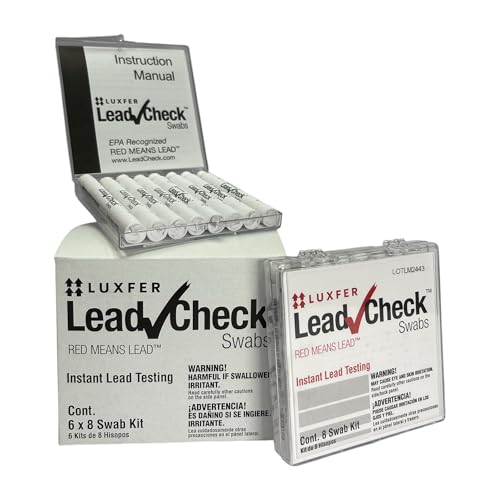
If you live in a home built before 1978, lead paint may be present on walls, trim, or windows. DIY test kits offer a quick, low‑cost way to screen for lead, but they are not a substitute for a full risk assessment.
This guide explains how the most common kits work, what the research says about their reliability, and how to decide whether a positive result means you need a certified inspector.
- DIY kits are screening tools only; they cannot quantify lead or replace a certified inspection.
- Chemical swab and colorimetric wipe kits detect surface lead above a threshold but may miss low‑level contamination.
- Research shows variable sensitivity across kits; false negatives are a known limitation [1].
- Use kits to prioritize rooms for professional testing, not to clear a home for occupancy.
- If any test is positive, or if high‑risk occupants live in the home, contact a licensed lead professional.
How DIY Lead Paint Test Kits Work
Most homeowner‑grade kits fall into two categories: chemical swab kits that change color when lead is present, and colorimetric wipe kits that you press against a surface and then compare to a reference chart. Both types are designed for rapid screening rather than precise measurement.
A typical swab kit contains a reagent‑filled tube or a pre‑moistened swab. You rub the swab on a painted surface, wait the instructed time (usually 30 seconds to a minute), and observe any color shift. Wipe kits work similarly but use a moistened pad that you press onto the area and then match the resulting hue to a printed scale.
These kits test only the surface layer they contact. They do not penetrate multiple paint layers, and they cannot quantify the exact lead concentration in parts per million. Results are reported as positive/negative or as a rough range (e.g., low, medium, high) based on the color intensity.
What the Research Shows About Kit Performance
A 1996 study examined a sodium rodizonate kit intended for home use on paint and soil samples and reported that the kit could detect lead in both matrices, though the authors noted variability in sensitivity [2].
More recent validation work has focused on screening kits for environmental lead hazards. A 2020 study evaluated a commercial screening kit and documented its ability to identify lead‑contaminated dust and paint in a controlled setting [3]. A 2024 investigation of a low‑cost kit designed for home environments found comparable detection limits but highlighted a higher rate of false‑negative results on surfaces with low lead loading [1].
Research using colorimetric wipes in the homes and vehicles of lead‑exposed construction workers demonstrated that wipe‑based methods can capture surface lead levels that correlate with occupational exposure, suggesting utility for spot checks in residential settings [4]. Across these studies, the consensus is that DIY kits are useful for initial screening but lack the quantitative accuracy required for regulatory compliance.

Choosing a Kit: Features, Cost, and Practical Tips
When shopping for a kit, look for products that reference EPA‑recognized test methods (e.g., EPA Method 3050B for paint or EPA Method 7000B for dust) on the packaging. Know what level a kit actually measures against. For paint, the federal lead‑based paint level is 1.0 mg/cm² or 0.5% lead by weight, and EPA‑recognized swab kits are evaluated against that level rather than reporting a lower detection limit of their own. For dust, EPA’s post‑abatement dust‑lead action level for floors is 5 µg/ft², so a screening product that cannot resolve down to that level cannot tell you whether a floor would pass clearance.

Price typically ranges from $10 to $50 per kit, with most packages containing 5–10 individual tests. Multi‑test kits are more economical if you plan to check several rooms or exterior surfaces. Check the expiration date; reagents degrade over time and can produce false negatives if used past their shelf life.
Practical tips: test in a well‑ventilated area, wear disposable gloves, and follow the manufacturer’s timing instructions exactly. Test multiple spots in each room — especially friction surfaces like window sills, door frames, and stair treads — because lead distribution is rarely uniform.
Interpreting Results and Next Steps
A positive color change indicates that lead is present above the kit’s detection threshold at the tested spot. It does not tell you the total lead load in the room, nor does it confirm that the hazard exceeds regulatory action levels. Treat any positive as a signal to investigate further.
A negative result means the kit did not detect lead above its limit at that specific location. Because false negatives can occur on low‑lead surfaces or if the reagent is expired, a negative result should not be taken as proof that the home is lead‑free, especially in pre‑1978 housing.
If you receive one or more positives, the recommended next step is to hire a certified lead inspector or risk assessor who can perform X‑ray fluorescence (XRF) analysis or laboratory‑based paint chip sampling. Those methods provide quantitative data needed for any abatement plan.

When to Hire a Professional
Professional testing is advisable whenever you have young children, pregnant occupants, or plan renovation work that will disturb painted surfaces. Certified inspectors follow EPA and HUD protocols, produce a written risk assessment, and can guide you through abatement options that meet local regulations.
Cost for a professional lead inspection typically starts around $300–$500 for a single‑family home and rises with the number of samples and travel distance. While more expensive than a DIY kit, the data you receive is legally defensible and essential for safe, compliant remediation.
FAQ
Can a DIY kit tell me if my home is safe for children?
No. A DIY kit only indicates whether lead is present above its detection limit at the tested spots. It cannot assess overall exposure risk or confirm compliance with safety standards. For a definitive answer, hire a certified lead risk assessor.
How many tests should I run in a typical room?
Test at least three locations per room — preferably a window sill, a door frame, and a baseboard — because lead paint deteriorates unevenly. More tests increase confidence but also cost.

Do expired kits give reliable results?
Expired reagents can lose reactivity, leading to false negatives. Always check the expiration date before use and replace kits that are past their shelf life.
What should I do if I get a positive result?
Treat a positive as a prompt for professional follow‑up. A certified inspector can quantify the hazard and recommend abatement or interim controls that meet regulatory requirements.
DIY lead test kits are screening tools only; they do not provide quantitative results or regulatory clearance. If you obtain a positive result, have young children or pregnant residents, or plan renovation that will disturb paint, engage a certified lead inspector or risk assessor for confirmatory testing and guidance on safe abatement.
References
- Validation of a low-cost lead hazard screening kit for the home environment. Integrated environmental assessment and management, 2024
- A sodium rodizonate lead testing kit for home use–valid for paint and soil samples?. Journal of toxicology. Clinical toxicology, 1996
- Validation of a screening kit to identify environmental lead hazards. Environmental research, 2020
- Using colorimetric wipes to characterize lead surface levels in lead-exposed construction workers’ homes and vehicles. Journal of exposure science & environmental epidemiology, 2026
These statements have not been evaluated by the Food and Drug Administration. This information is not intended to diagnose, treat, cure, or prevent any disease. Content is for informational purposes only and is not medical advice; consult a qualified healthcare provider before starting any supplement. As an Amazon Associate we earn from qualifying purchases.