Consumer and professional-grade lead paint equipment differ significantly, reflecting the more specialized nature of this hazard.
- Testing has a genuinely significant technology gap between consumer swab kits and professional XRF.
- Remediation equipment is more similar between DIY and professional use — training/certification is the bigger differentiator there.
- Professional XRF testing is worth the investment for decisions requiring precise, defensible data.
- This technology gap is more pronounced for lead than for some other hazards covered on this site.
Testing Equipment: A Significant Gap
Unlike some hazards where consumer and professional testing use similar underlying methods, lead testing has a genuinely significant gap — consumer swab kits and professional XRF are fundamentally different technologies with different precision levels, not just different price tiers of similar equipment.
The gap is one of kind rather than degree. A consumer swab returns a qualitative presence or absence result at the spot it touches, while a professional XRF analyser returns a quantitative concentration reading and can read through multiple paint layers without disturbing the surface. Those answer different questions, so no amount of careful swab testing substitutes for the measurement.
The difference in what the result can be used for follows from that. Quantitative readings, recorded by component across a house, are what produce a report that a permit office, a lender, a state registry, or a contractor bidding the work will accept. Renting an XRF analyser is possible at roughly $150 to $300 per day plus per-reading fees, but the instrument is only part of it, since interpretation and documentation are what the certification covers.
Remediation Equipment: More Similar
Containment supplies, respirators, and HEPA vacuums used by professionals are largely similar to what’s available for DIY purchase — the meaningful professional difference here is training and certification, not fundamentally different hardware.
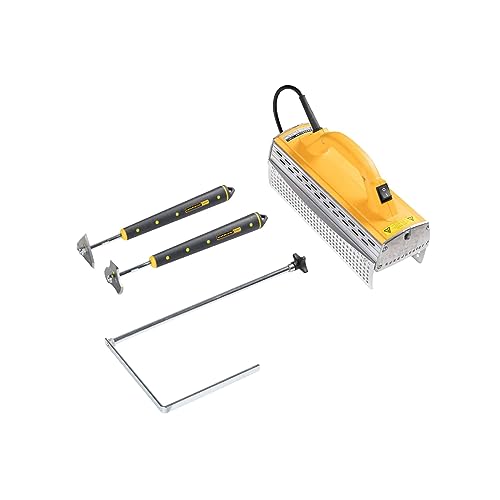
On the remediation side the convergence is real. A homeowner can buy the same categories of equipment a contractor uses: true HEPA sealed-system vacuums, P100 respiratory protection, plastic sheeting and containment supplies, and low-temperature infrared paint removal systems that soften coatings without the vaporisation risk of open flame or high-temperature heat guns.
What differs is scale and endurance rather than principle. Contractor machines are built for daily use and larger volumes, and professional containment can include negative-pressure enclosures that are impractical for a single-room homeowner project. For a room at a time, well-chosen homeowner-scale equipment used correctly is genuinely capable, which is why equipment is rarely the binding constraint on a small job.
When Professional-Grade Testing Actually Matters
Given the significant technology gap for testing specifically, professional XRF is worth the investment for any decision requiring precise, defensible data — real estate transactions, pre-renovation planning, or comprehensive risk assessment.
It matters whenever the output has to satisfy somebody else. Permits for work disturbing lead-based paint, HUD-funded rehabilitation financing, state lead-safe housing registries, contractor bidding, and clearance examinations after disturbance all rest on documentation from a certified professional. A homeowner swab result, however carefully taken, does not fill that role.
It also matters whenever the question is how much rather than whether. Prioritising components across a whole house, deciding between encapsulation and removal on a given surface, or investigating a child’s elevated blood lead result all depend on quantitative data and on dust assessment. Those are risk assessment tasks, at roughly $500 to $1,200, and they are usually cheaper than the wrong remediation decision.

What Certification Buys Beyond the Instrument
Certification covers sampling design, interpretation, and documentation rather than access to hardware. Knowing which components to sample, how many readings a defensible survey requires, how to collect dust wipes so the result means something, and how to write a report that a permit office will accept are the substance of the qualification. Renting the analyser without that produces numbers rather than an assessment.
There is also a chain-of-custody dimension. Dust wipes are analysed by an accredited laboratory, and clearance depends on samples collected and handled by someone whose certification stands behind the result. Self-collected wipes remain genuinely useful as a before-and-after check on your own cleanup, but they cannot substitute where a formal record is required.
A Practical Split for Most Homeowners
The allocation that tends to work is to buy remediation equipment and hire testing expertise. Homeowner-scale HEPA vacuums, P100 respirators, containment supplies, and wet methods are worth owning because they are used repeatedly across a phased project and cleanup is where a job succeeds or fails. Testing expertise is needed at a few discrete decision points, which is exactly the pattern that favours hiring over buying.
Within that split, consumer swab kits still earn their place as a screening tool for prioritising which rooms and components deserve professional attention first [1]. Used that way, alongside a recognised kit and an understanding of what a spot negative does not cover, they are a reasonable few hundred dollars rather than a false economy.
FAQ
Is the gap between consumer and professional lead testing bigger than for other home hazards?
Yes, generally — XRF technology provides a meaningfully different precision level than consumer swab kits, a bigger gap than for some other hazards where consumer and professional testing use more similar methods.
Can I rent an XRF analyser and do it myself?
Rental is available at roughly $150 to $300 per day plus per-reading fees, but the instrument is the smaller part of the job. Sampling design, interpretation, and documentation are what certification covers, and a self-generated reading will not satisfy permit, financing, registry, or clearance requirements.
Is contractor-grade remediation equipment worth it for one project?
For a room at a time, homeowner-scale equipment used correctly is generally sufficient, and an eight-gallon HEPA machine is the practical size. Contractor-grade machines buy endurance and volume rather than a different standard of filtration, which matters on larger or repeated work.
Where is the line where I should stop and hire out?
Structural demolition, large-scale removal, any work generating significant dust, and anything requiring a permit or clearance are the usual boundaries. Limited encapsulation or enclosure of a single room with proper protection, containment, and a HEPA vacuum is within reach of a careful homeowner.
For decisions requiring precise data, professional XRF testing is worth the investment given this significant technology gap.
References
- Lead Test Kits. U.S. Environmental Protection Agency
These statements have not been evaluated by the Food and Drug Administration. This information is not intended to diagnose, treat, cure, or prevent any disease. Content is for informational purposes only and is not medical advice; consult a qualified healthcare provider before starting any supplement. As an Amazon Associate we earn from qualifying purchases.
